
When a damp patch appears on an interior ceiling, or a freeholder submits a claim for water damage to external brickwork, the first question an insurer asks is simple: when were the gutters last cleaned, and can you prove it? The answer to that question - and the quality of the evidence - now determines whether a claim succeeds or fails.
Why Insurers Are Tightening Maintenance Requirements
Every standard building insurance policy in the UK contains a maintenance clause. The wording varies by insurer, but the principle is consistent: the policyholder must keep the property in a reasonable state of repair. Damage that results from gradual neglect - rather than a sudden, unforeseen event - is classified as a maintenance failure and excluded from cover.
Gutters sit squarely in this territory. Blocked gutters are not a sudden event; they develop over months or years. When a claim arrives citing water damage to soffits, fascias, external render or internal ceilings, and an adjuster determines the cause was gutter overflow, the insurer's next step is to look for evidence that the gutters were being maintained.
If that evidence does not exist, the claim is likely to be declined - even if the property was being looked after in good faith.
What Counts as Adequate Maintenance Evidence
There is no single national standard that defines what "adequate" gutter maintenance looks like for insurance purposes. However, based on common policy wording and claims handling practice, the following elements carry the most weight:
- Date-stamped photographic evidence - photographs taken at the time of the clean, showing the gutter interior before and after, and confirming that the work was done properly rather than symbolically.
- A named contractor or operator - evidence from a traceable, identifiable business rather than an anonymous cash-in-hand job.
- Proof of access method - an adjuster looking at close-up interior gutter photographs will know whether they were taken at range (via a pole camera) or at genuine close range from a platform. The latter carries more weight.
- Regularity - a single historic clean is far weaker than a pattern of annual or bi-annual maintenance documented across several years.
- Condition notes - any record of what was found (debris type, debris volume, condition of seals and brackets) and what action was taken.
Why Method Matters: Hand Cleaning vs Vacuum Systems
The cleaning method is more important for insurance purposes than most property owners realise. There are two broad approaches to gutter cleaning from height:
Vacuum or remote pole systems extract debris from ground level using a long carbon fibre pole and a camera attachment. This is fast and avoids the cost of access equipment, but it produces camera footage of the gutter interior rather than true close-range inspection. Debris in corners, failed joint sealant, cracked sections and sagging runs can be missed.
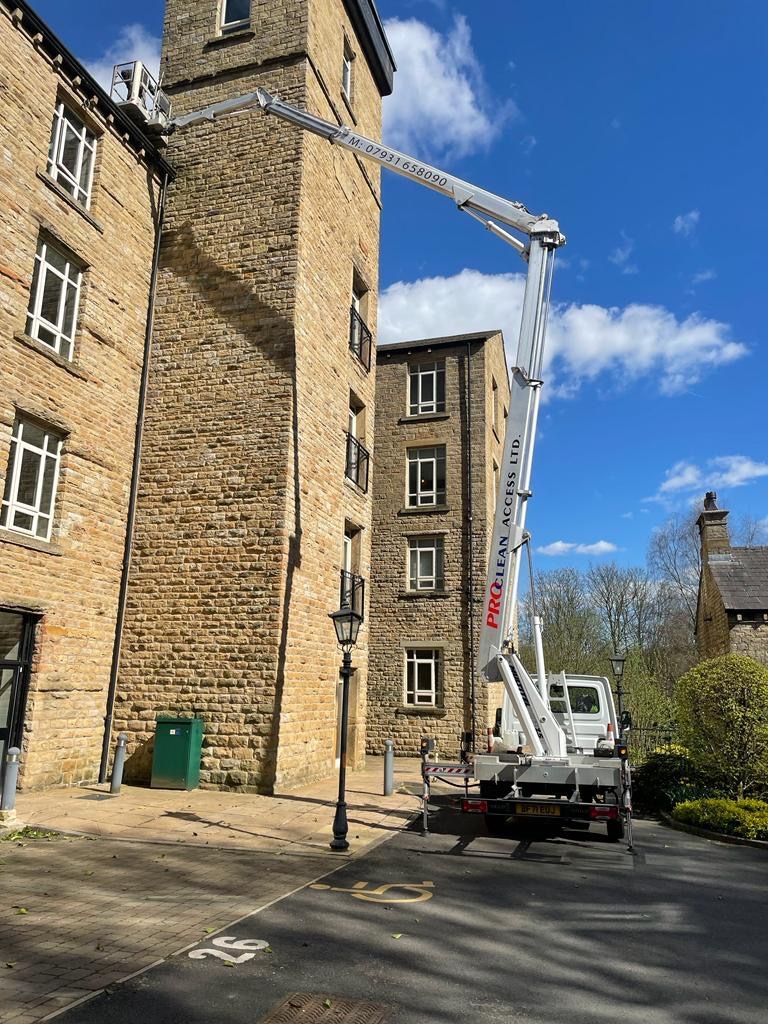
Hand cleaning from an access platform means the operative is physically positioned at gutter level, clearing debris by hand, physically testing downpipe flow, inspecting bracket fixings and joint seals and photographing from a position that shows genuine close-range evidence.
For insurance purposes, the photographic record from a hand-clean at close range is significantly stronger. The images show unambiguously that a person was present at the gutter and carried out a thorough inspection - not a remote process that could have missed a blocked outlet behind a leaf mat.
Frequency: What Is Reasonable?
Most UK property insurers consider annual gutter cleaning to be a reasonable maintenance standard for the majority of properties. Properties in the following situations benefit from cleaning twice a year - typically once in spring and again in late autumn after leaf fall:
- Properties adjacent to or beneath deciduous trees
- Properties with slate or stone tile roofs that shed significant grit
- Properties with valley gutters or complex rooflines that accumulate debris faster
- Multi-unit buildings where a single overflow can cause damage across several flats
For managing agents and freeholders of leasehold blocks, the duty is reinforced by the Landlord and Tenant Act 1985 (Section 11), which implies an obligation to keep the structure in repair. Gutters are part of the structure, and an insurer or Housing Ombudsman finding against a managing agent for gutter-related water ingress will look at whether a maintenance schedule was in place and documented.
Managing Agents: The Service Charge Evidence Trail
For blocks of flats and managed commercial properties, gutter cleaning costs are typically recovered through the service charge. This creates an added layer of accountability: leaseholders can challenge service charge expenditure, which means the managing agent must be able to demonstrate not just that a contractor was paid, but what work was done, when and to what standard.
A photographic report - showing each section of guttering cleaned, with before-and-after images and a note of any defects found - provides a defensible maintenance record that satisfies both insurance evidence requirements and service charge scrutiny.
What ProClean Access Provides
Every gutter clean carried out by ProClean Access is done by hand, at close range, from our own access platform. We do not use vacuum systems or pole cameras - we position the platform at gutter height and work along the full run physically, clearing every section by hand, flushing downpipes and checking bracket fixings and joint seals as we go.
At every stage, we photograph what we find - before clearing begins, mid-clean to document debris volumes and on completion to show the cleared gutter and confirmed downpipe flow. Where we identify defects such as cracked sections, failed joints or loose brackets, we photograph these separately and document them in a written note provided alongside the image set.
This record can be submitted directly to a property insurer, managing agent, freeholder or Housing Ombudsman as evidence of proper maintenance carried out to close-range professional standard.
We offer one-off cleans for residential and commercial customers, and recurring maintenance contracts - annual, bi-annual or tailored to your property's specific requirements - so that the evidence trail builds over time rather than depending on a single visit.
Summary
- UK building insurance policies require properties to be kept in good repair; gutter-related damage from neglect is routinely excluded from cover.
- Photographic evidence of regular, thorough cleaning is the most effective way to protect a claim - and the quality of that evidence matters.
- Hand cleaning from an access platform produces stronger evidence than vacuum or pole camera systems.
- Annual cleaning is the baseline; twice yearly is recommended for high-risk properties.
- Managing agents face additional obligations under leasehold law and service charge regulations, making a documented maintenance trail essential.
ProClean Access carries out all gutter cleaning by hand, at close range, from our own IPAF-certified access platforms - with full photographic evidence provided after every job.
Get a Free Quote WhatsApp