
The UK's rain does clean solar panels - partially. But accumulated grime, lichen and bird fouling reduce output in ways that rain alone will not reverse. Here is what the research says about output loss, how often panels actually need cleaning and why the access method matters.
How Much Output Do Dirty Panels Lose?
Studies on solar panel soiling in the UK suggest panels operating under typical conditions can lose between 5% and 25% of rated output when significantly dirty. The variance is wide because it depends on factors including local air quality, proximity to agricultural land (dust and pollen), bird activity, the pitch of the roof and how long since the panels were last cleaned.
A commonly cited figure for a lightly dirty UK panel is 5–10% output loss. For panels with established lichen growth, heavy bird fouling or years of accumulated grime on south-facing flat or low-pitch roofs, losses at the higher end of that range are realistic.
On a typical 4kW domestic installation generating around 3,400 kWh per year, a 10% output loss equates to roughly 340 kWh of lost generation annually - a meaningful efficiency gap that a single cleaning can largely close.
Why Rain Is Not Enough
Rain provides effective self-cleaning on steeply pitched, south-facing panels in exposed locations - particularly if there are no trees overhead and no significant bird activity. On these installations, cleaning every 2–3 years may be sufficient.
Rain is significantly less effective in the following situations:
- Low-pitch and flat-roof installations - water pools rather than runs off, leaving a residue of dissolved minerals and debris as it evaporates.
- Panels beneath trees - sap, pollen and leaf debris accumulate faster than rainfall can remove them.
- Agricultural locations - dust and airborne particles from soil, crop harvest and livestock areas are heavy and sticky.
- Panels with established lichen or moss growth - once biological growth establishes on the panel surface, rain will not shift it. Professional cleaning with appropriate technique is needed.
- Bird roosting areas - bird fouling is acidic and etches into anti-reflective coatings over time. It does not rinse off cleanly in rain.
The Right Cleaning Method
Manufacturers specify soft-brush cleaning with purified water as the accepted method for photovoltaic panels. The reasons are straightforward:
- Purified water (deionised or reverse-osmosis filtered) leaves no mineral residue when it dries - tap water leaves limescale deposits that reduce panel efficiency over time.
- Soft brush agitation lifts lichen, moss and stubborn bird fouling that water alone will not shift.
- No pressure washing - high-pressure washing risks penetrating panel frame seals and voids most manufacturer warranties. Several major panel manufacturers explicitly state that pressure washing constitutes misuse of the product.
- No detergents or chemicals - surfactants and cleaning chemicals can degrade the anti-reflective coating applied to most modern panels and may also void warranties.
Why Access Equipment Matters
Solar panels are most commonly installed on roof slopes - which means they are typically only accessible from above or from a position level with the roof surface. Cleaning from the ground using a pole-fed brush system works for simple, accessible arrays on lower-pitch roofs, but is limited by pole reach and the angle of application.
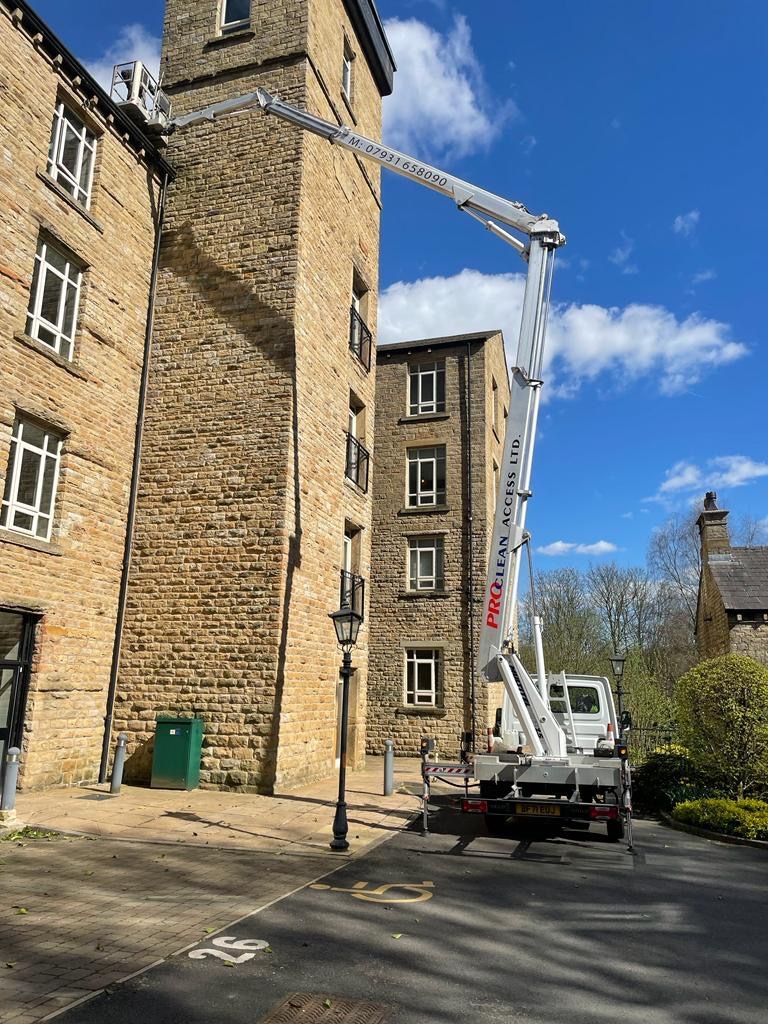
For panels on higher roofs, agricultural buildings or flat-roof commercial installations, an access platform positioned at panel height is the practical solution. It allows the operative to apply consistent pressure along the full panel surface, verify the result visually and identify any panel defects (damaged frames, failed junction boxes, broken cells) that would otherwise go undetected until the next inverter output check.
Climbing onto a roof to clean panels is strongly inadvisable - most manufacturer warranties explicitly exclude damage resulting from roof access, and the risk of roof tile damage is significant.
Frequency: What ProClean Access Recommends
- Most domestic pitched-roof installations: annual clean in spring, when winter grime, moss spores and lichen can be cleared before the peak generation months of April–September.
- Agricultural and commercial flat-roof arrays: bi-annual cleaning - spring and autumn - to manage dust, pollen and harvest-season particulate.
- Panels with established lichen or heavy bird fouling: initial professional clean to clear established growth, then annual maintenance to prevent recurrence.
ProClean Access carries out solar panel cleaning using soft brush and purified water from our own IPAF-certified access platforms. We work on domestic arrays through to large agricultural and commercial installations across Yorkshire and Lancashire.
Restore your panels' output with soft brush, purified water cleaning from a certified access platform - no standing on panels, no pressure washing, no warranty risk.
Solar Panel Cleaning Get a Quote